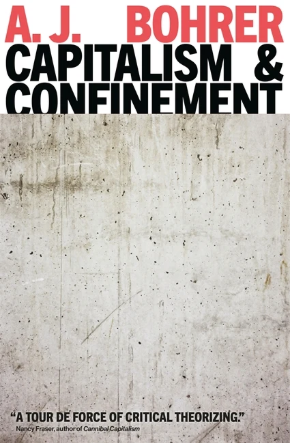
A dynamic system of perpetual movement, Capitalism is paradoxically dependent on means of confinement— in land, labor, and life
Goods, capital, and people move around the world faster and over greater distances than ever before. But capitalism’s voracious expansion violently imposes confinement at every turn in the form of border walls, prisons, police, and property lines. Our lives are constricted in more subtle ways as well, through wages, the state, and social reproduction. Capitalism and Confinement examines why confinement seems to be intensifying, who benefits, and what we can do about it.
What people are saying.
“An urgent book—ambitious, relentless, and driven by palpable tension and unbearable grief— Bohrer draws close attention to capitalism’s tendency to separate people through multiple configurations of confinement. From the historic enclosures, to prison, to the family itself, capitalism continually reproduces the methods and means to cleave people away from each other in ways that undermine, if not obliterate, our capabilities of uniting to transform our societies. Abolition communism then is proposed as a political intervention that allows us to overcome and eventually end capitalism.”
—Keeanga-Yamahtta Taylor, author of Race for Profit
“A. J. Bohrer always opens my eyes, fortifies my mind, and straightens my spine, but this book is an especially precious tour de force. Its purview is ambitious, yet the story Bohrer tells is accessible and completely convincing to almost anyone, as well a poetic tearjerker to boot. This beautiful book offers us a soundly backed, crystal clear re-telling of the nature of the proprietary, enclosed, dominated, genocidal world we inhabit (for now). The incisiveness, integrity, and sheer heart of this work will transform you forever.”
—Sophie Lewis, author of Abolish the Family
“Bohrer’s insightful and accessible treatise makes the case that any effort to create broad solidarities to resist capitalism requires including a direct response to its confining characteristics. We cannot treat criminalization, border restrictions, and police violence as anything other than core features of capitalist exploitation.”
—Alex Vitale, author of The End of Policing
“A tour de force of critical theorizing. By putting the widely discussed notion of the carceral into communication with the once-again salient concept of capitalism, A.J. Bohrer says something new and revelatory about both.”
— Nancy Fraser, author of Cannibal Capitalism
"Bohrer's book on carcerality makes a singular contribution to a fast-growing field of prisons, detention, and abolitionist scholarship…Against the more purist view that under capitalism the economy produces social relations, remaining the primary cause and structure, Bohrer insists that geopolitical considerations, including different histories of colonialism, race, gender, and other social vectors of power, all inform the forms of capitalism we see, and that no analysis of prison institutions can be comprehensive without this kind of multi-faceted framework."
— Judith Butler, author of The Force of Non-Violence
"Recasting capitalism through the lens of confinement, A.J. Bohrer illuminates the articulation of labor, property, borders, policing, prisons, and care in the production and governance of social life…This is a timely and much-needed book in an age of war and genocide."
— Sandro Mezzadra, author of The Rest and the West
"In an age obsessed with global flows--of capital, goods, people—Capitalism and Confinement shifts our attention to the walls, borders and enclosures underpinning all that movement. Drawing on everything from the plantation to the prison to the West Bank, A.J. Bohrer offers a unified theory of capitalism as a system of confinement, one that helps explain why freedom remains so elusive even as the world grows ever more interconnected. This is not just an important book – it is an urgent one."